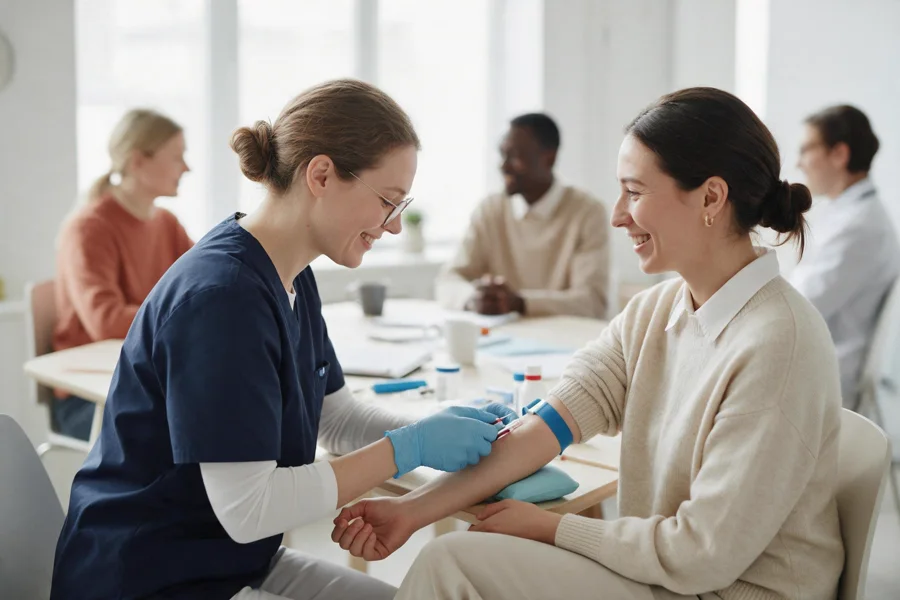
Occupational health care (in Swedish, företagshälsovård or FHV) is the independent expert resource an employer uses to prevent and manage work-related ill health. Traditionally it has been reactive — you call it when someone is already injured, burned out or on sick leave. But that is only half of what it can be. The more valuable model is preventive company health (arbetshälsa): read the health of the workforce early, act on measurable risk, and stop problems before they cost people and productivity. This article explains what FHV covers under Swedish rules, where the reactive model falls short, and what a preventive, data-led approach adds.
What FHV actually covers in Sweden
Under the Work Environment Act (Arbetsmiljölagen), an employer must provide access to occupational health services to the extent the work conditions require. The law defines FHV as an independent expert resource in the areas of work environment and rehabilitation, with the competence to identify and describe the links between the work environment, organisation, productivity and health. In practice that means ergonomics assessments, statutory medical checks for hazardous work, workplace risk assessments, rehabilitation coordination and psychosocial support.
These are important and, in many cases, legally required. But notice the framing: the classic FHV engagement begins once a risk or an injury is already on the table. It is expert help, delivered late.
Why the reactive model is expensive
Sick leave is one of the largest controllable costs an employer carries. According to Försäkringskassan, the most common diagnoses behind long-term sickness benefit in Sweden are psychiatric conditions such as stress-related exhaustion, followed by musculoskeletal disorders — both of which develop gradually and are, in principle, detectable early. Statistics Sweden (SCB) tracks sickness absence as a share of contracted hours across the labour market, and it moves with workload, age profile and organisational health.
The problem with a purely reactive model is timing. By the time someone is signed off, the biological, psychological and organisational risk factors have usually been building for months or years. Rehabilitation is slower, more expensive and less certain than prevention. A model that only activates at the point of absence is, by design, always one step behind.
What preventive company health looks like
Preventive arbetshälsa asks a different question: what can we measure now, while everyone is still well, that tells us where risk is accumulating? This is where a data-led approach goes further than a single annual doctor's visit.
A modern programme reads three dimensions together — what Pheno calls the 360. First, physical health through blood biomarkers (for example markers linked to metabolic, cardiovascular and inflammatory risk). Second, mental wellbeing through validated questionnaires rather than guesswork. Third, wearable integration — steps, resting heart rate and sleep — for the day-to-day signal that a snapshot misses. Read together, these give a fuller picture than any single measure, and they surface patterns early enough to act on.
Crucially, this is about the workforce, not surveillance of individuals. The employer only ever sees aggregated, anonymised data — never any single person's results. Prevention at the organisational level; privacy at the individual level.
Where the two models meet
Preventive company health does not replace statutory FHV — it strengthens it. Ergonomics, rehabilitation and legally required medical checks still belong to the occupational-health function. But layering early, measurable insight on top means the reactive services are called on less often, because more risk is caught and addressed while it is still cheap and reversible to do so. The best programmes treat prevention and reaction as one continuous system, not two disconnected services.